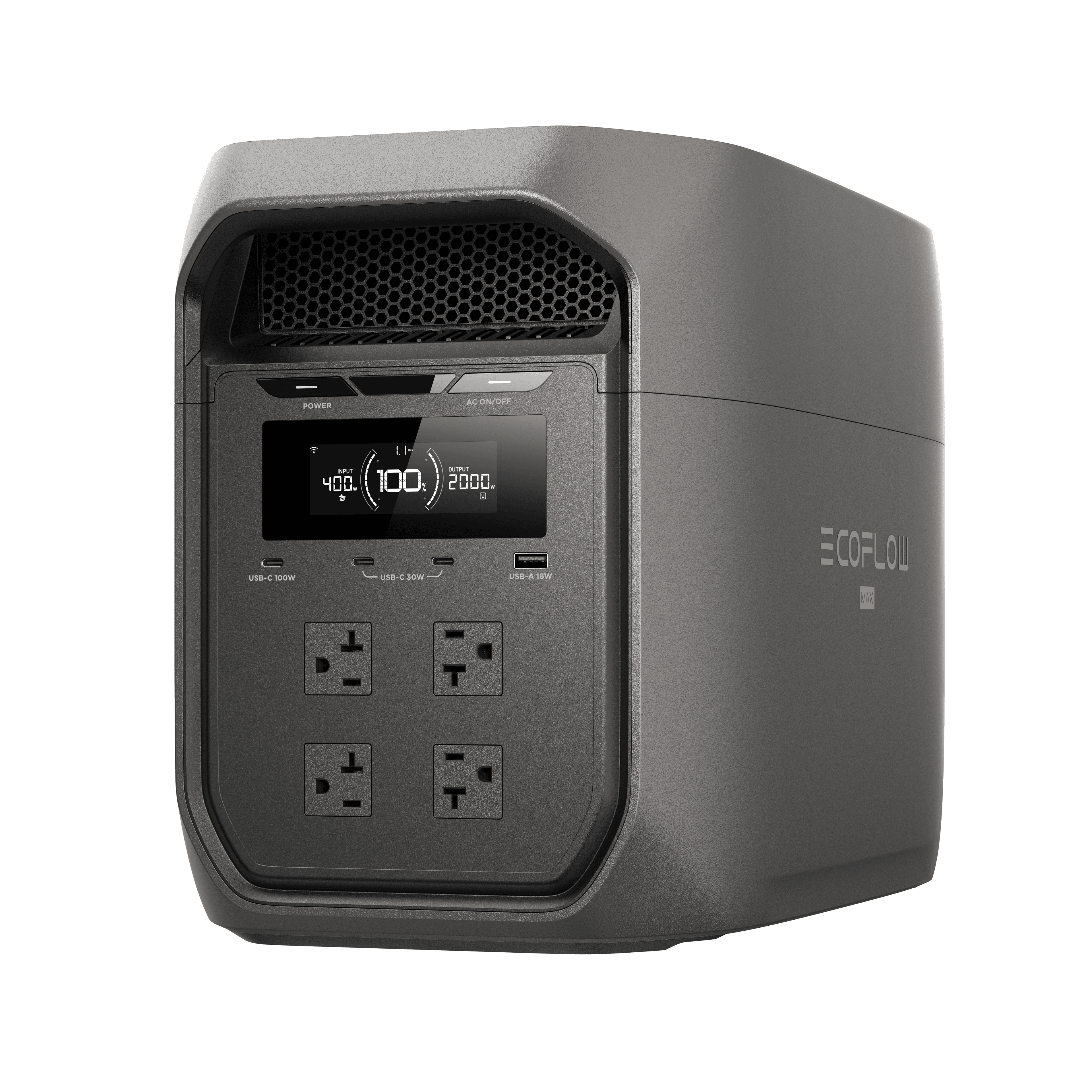
The EcoFlow Delta 3 Max slots into EcoFlow's 2025 lineup as the high-capacity workhorse of the Delta 3 family. It doubles the capacity of the Delta 3 Plus to 2048Wh and bumps continuous output to 2400W, targeting buyers who need serious backup power without stepping up to the Delta Pro 3 price bracket. At $799, it undercuts most 2kWh competitors on price while delivering fast charging, near-silent operation, and EcoFlow's polished app ecosystem.
But the Delta 3 Max also makes real trade-offs to hit that price. No expansion batteries. A 500W solar input cap that feels conservative for a unit this size. And a USB-C port configuration that favors quantity over power delivery. This review breaks down where those trade-offs matter and where they do not.
Build Quality and Design
EcoFlow's CTC (cell-to-chassis) construction, borrowed from electric vehicle battery architecture, is the defining engineering choice in the Delta 3 Max. Instead of housing battery cells in a separate module inside an outer shell, the cells are integrated directly into the structural chassis. The result: a unit that weighs 44.8 lbs for 2048Wh, roughly 13% lighter than previous-generation 2kWh stations from EcoFlow and competitors.
At 19.4 x 9.4 x 12.0 inches, the Delta 3 Max is compact for its capacity class. The matte dark finish resists fingerprints, and the build quality is unmistakably premium. Panels fit flush, buttons have satisfying tactile feedback, and nothing rattles when you move the unit.
Port layout follows the Delta 3 family's front-facing design philosophy. All four AC outlets, three USB-C ports, and the single USB-A port face forward. The 12V DC car socket sits on the side. This is a meaningful improvement over older models that spread ports across multiple faces, forcing awkward cable routing. For home backup setups where the station sits on a shelf, front-facing ports simplify everything.
The handle is integrated and sturdy, though at nearly 45 lbs, carrying the Delta 3 Max any real distance is a two-person job. If portability is your top priority, the Delta 3 Plus at 25.4 lbs is significantly easier to move.
Charging Speed
Fast AC charging is where EcoFlow consistently leads, and the Delta 3 Max continues that tradition. Plugged into a standard wall outlet, it pulls up to 1800W and reaches 80% in approximately 68 minutes. A full charge completes in about 90 minutes. For a 2048Wh battery, that speed is exceptional.
To put this in perspective: the Delta 3 Plus fills its smaller 1024Wh battery in about 56 minutes. The Delta 3 Max takes only 12 more minutes to reach 80% despite having double the capacity. If you need to top off before an approaching storm or pack for a camping trip, 68 minutes from empty to 80% is fast enough to be genuinely practical.
The charging curve follows the standard lithium pattern: fast to 80%, then gradually tapering to protect long-term cell health. EcoFlow's battery management system handles this automatically, and the OASIS 3.0 app lets you set charge limits if you want to cap at 80% for daily use.
Solar Charging
Solar input tops out at 500W via the integrated XT-60 connector. In our testing with a pair of EcoFlow 220W bifacial panels on a clear spring day, we saw consistent 370-400W input. A full solar charge from empty took roughly 5-6 hours under real-world conditions, accounting for cloud cover and angle changes throughout the day.
The 500W cap is the Delta 3 Max's most notable limitation compared to the Delta 3 Max Plus, which accepts up to 1000W of solar input. If you plan to rely heavily on solar (off-grid camping, extended RV trips), the Plus model's doubled solar input translates to significantly faster recharge times. For occasional solar supplementation, 500W is adequate.
Other Charging Methods
The Delta 3 Max also charges via a 12V car outlet or a gas generator. Car charging is slow (12V input), making it a backup option rather than a primary method. Generator charging works at the same rate as AC wall charging, useful for extended off-grid scenarios where you have a gas generator available.
Output and Ports
The Delta 3 Max delivers 2400W of continuous AC output through four 120V outlets, with surge capacity of 4800W for startup loads from compressors and motors. EcoFlow's X-Boost feature pushes software-managed output to 3400W for resistive loads like space heaters and hair dryers, though this comes with reduced efficiency.
Port Breakdown
| Port | Count | Max Output |
|---|---|---|
| AC outlets (120V) | 4 | 2400W total |
| USB-C | 1 | 100W PD |
| USB-C | 2 | 30W each |
| USB-A | 1 | 18W QC |
| DC car socket | 1 | 126W (12.6V/10A) |
The port configuration works well for most scenarios, but there is an important distinction from the Delta 3 Plus. The Plus model has two USB-C ports rated at 140W each, capable of fast-charging modern laptops at full speed. The Delta 3 Max's single 100W USB-C port handles most laptop charging fine, but the two additional USB-C ports at 30W are limited to phones and tablets. If you regularly charge two high-wattage laptops simultaneously, the Delta 3 Plus actually outperforms the Delta 3 Max in USB-C delivery.
Real-World Runtime Tests
We tested the Delta 3 Max with common appliances to measure actual runtimes against the 2048Wh rated capacity:
- Mini-fridge (55W average): 28.5 hours continuous
- Full-size refrigerator (120W average): 13.2 hours
- Laptop via USB-C (65W): 24 full charges
- CPAP machine (25-30W): 5+ full nights
- Electric kettle (1500W): 8 boils from cold
- Projector + sound system (280W): 5.5 hours of movie night
- WiFi router (15W): 4+ days continuous
- Space heater on low (750W): Approximately 2 hours
Measured efficiency came in at approximately 79% for AC loads, meaning roughly 1,618Wh of the 2048Wh rated capacity translates to usable AC power. This is typical for the category and consistent with what we see from other LFP-based stations.
Battery and Longevity
The Delta 3 Max uses automotive-grade full-tab LFP (Lithium Iron Phosphate) cells rated for 3,000+ cycles to 80% capacity. At one full cycle per day, that translates to over 8 years of daily use before the battery degrades to 80% of its original capacity. At a more typical 2-3 cycles per week, the battery should last well over a decade.
LFP chemistry offers several advantages over the NMC (Nickel Manganese Cobalt) cells found in older power stations: longer cycle life, better thermal stability, lower fire risk, and more consistent voltage output throughout the discharge curve. The trade-off is slightly lower energy density, but EcoFlow's CTC construction mitigates the weight penalty.
The battery management system handles cell balancing, temperature monitoring, overcharge protection, and low-temperature cutoff automatically. Discharge works down to 14F (-10C), but charging requires temperatures above 32F (0C). For cold-climate users, this means you can draw power in freezing conditions but need to bring the unit indoors (or into a heated vehicle) to recharge.
EcoFlow backs the Delta 3 Max with a 3-year standard warranty, extendable to 5 years with product registration. Given the 3,000+ cycle LFP rating, the battery itself should far outlast the warranty period under normal use.
App and Ecosystem
EcoFlow's OASIS 3.0 app connects via both WiFi and Bluetooth, and it remains the best companion app in the portable power station market. The interface is clean, responsive, and packed with genuinely useful features:
- Real-time monitoring: Input/output wattage, battery percentage, estimated time remaining, and temperature readings update every few seconds.
- Historical data: Charge and discharge history with charts showing usage patterns over days, weeks, and months.
- Firmware updates: Over-the-air updates keep the BMS and inverter firmware current.
- Charge scheduling: Program charging windows around time-of-use electricity rates to minimize energy costs.
- Storm Guard Mode: When enabled, the station monitors weather alerts and automatically charges to 100% before severe weather hits your area.
- Custom charge limits: Set maximum charge levels (e.g., 80%) for daily use to extend battery lifespan.
Remote monitoring works over WiFi even when you are away from home, so you can check battery levels and power consumption from anywhere. The Bluetooth connection serves as a local fallback when WiFi is unavailable.
The app also integrates across the broader EcoFlow ecosystem. If you own EcoFlow solar panels, smart plugs, or other Delta units, they all appear in a single dashboard. This ecosystem cohesion is a genuine advantage over brands that treat each product as a standalone island.
How It Compares to the Delta 3 Plus
Buyers considering the Delta 3 Max will inevitably compare it to the Delta 3 Plus. Here is how they stack up:
| Spec | Delta 3 Max | Delta 3 Plus |
|---|---|---|
| Capacity | 2048Wh | 1024Wh |
| Output | 2400W / 4800W surge | 1800W / 3600W surge |
| Weight | 44.8 lbs | 25.4 lbs |
| Price | $799 | $999 |
| USB-C (max per port) | 100W | 140W |
| Solar input | 500W | 500W |
| AC charge (0-80%) | 68 min | 43 min |
| Battery cycles | 3,000+ | 4,000+ |
| Expandable | No | Yes (with Extra Battery) |
| Noise | 25dB at 600W | 30dB at light loads |
The Delta 3 Max wins on raw capacity and output for less money. The Delta 3 Plus wins on portability, USB-C power delivery, expandability, and cycle life. Choosing between them depends on your priorities: if you need maximum stored energy for home backup or extended off-grid use, the Max delivers double the capacity for $200 less. If you value portability and plan to expand later, the Plus is the smarter foundation.
For most home backup scenarios, the Delta 3 Max's 2048Wh is the sweet spot. It can run a refrigerator through a 12-hour outage, keep a home office operational for a full workday, or power essential medical devices like CPAP machines for multiple nights.
Real-World Testing Scenarios
Home Backup
We simulated a power outage running a standard refrigerator, WiFi router, and phone charging station simultaneously (approximately 140W average draw). The Delta 3 Max lasted 11.5 hours before hitting 10% battery. The 10ms UPS switchover kept the router and connected devices running without interruption when we cut wall power.
For homeowners in storm-prone areas, the Storm Guard feature is especially practical. When severe weather is forecast, the station automatically charges to full, ensuring maximum capacity when you need it most. Combined with the UPS functionality, the Delta 3 Max works as both a proactive and reactive backup solution.
Camping and RV
At a campsite, the Delta 3 Max powered a 12V cooler, LED string lights, phone and camera charging, and a small portable fan through two full days without solar supplementation. Adding a single 220W panel extended runtime to four days of comfortable use.
The 25dB noise level at moderate loads is a significant advantage at campsites. At 600W or below, the unit is essentially silent at conversational distances. Neighboring campers will not hear it. Under heavier loads the fans increase, but they remain quieter than most competitors in this capacity class.
The 44.8 lb weight is the camping trade-off. Unlike the 25.4 lb Delta 3 Plus, the Max requires deliberate setup. It is a car-camping or RV station, not a backpacking one. If you are loading it into a vehicle once and leaving it in place for the trip, the weight is a non-issue. If you need to carry it any distance from the car, plan on two people.
Remote Work
Running a laptop (65W), external monitor (45W), and desk lamp (10W) for a full 8-hour workday consumed roughly 960Wh, leaving the Delta 3 Max with 53% battery remaining. That is a full two-day buffer for a work-from-anywhere setup without recharging. Paired with a single solar panel, you could work indefinitely.
Who Should Buy the EcoFlow Delta 3 Max
Buy it if you need:
- Affordable 2kWh home backup power (the best value in the 2048Wh class)
- A station that can run a refrigerator through an overnight outage
- Fast AC charging for last-minute storm preparation
- Quiet operation for camping or bedroom use
- Reliable UPS protection for a home office or networking equipment
Consider the Delta 3 Plus instead if you:
- Prioritize portability (19 lbs lighter)
- Need 140W USB-C for fast laptop charging
- Want the option to expand capacity later with extra batteries
- Use the station primarily for camping where weight matters
Step up to the Delta Pro 3 if you:
- Need whole-home backup capacity (4kWh+)
- Want to integrate with a home electrical panel
- Need higher continuous output (above 2400W)
- Plan to build a full home energy system
Our Verdict
The EcoFlow Delta 3 Max earns a 4.5/5 rating. It delivers the best price-to-capacity ratio in the 2kWh class, with genuinely fast charging, near-silent operation, strong UPS functionality, and EcoFlow's class-leading app. The CTC construction shaves meaningful weight from what could easily be a 50+ lb unit.
The half-point deduction reflects three real limitations: the 500W solar input cap feels restrictive for a station this capable, the non-expandable design limits long-term flexibility, and the USB-C port configuration prioritizes port count over per-port power delivery. These are deliberate cost-saving choices that EcoFlow made to hit the $799 price, and for many buyers they will not matter. But if solar charging speed, future expandability, or high-wattage USB-C are priorities, the Delta 3 Max Plus ($1,049) addresses all three.
For the majority of buyers seeking a reliable, high-capacity power station for home backup, car camping, or emergency preparedness, the Delta 3 Max is the value leader in 2026.
Related Reading
- EcoFlow Delta 3 Plus Review (lighter, more portable sibling)
- EcoFlow Delta Pro 3 Review (whole-home backup tier)
- Best EcoFlow Power Stations
- Best Power Stations for Home Backup
- Best 2000W Power Stations
- Best Portable Power Stations of 2026
- Guide: LFP vs NMC Battery Types Explained
- Guide: How to Charge With Solar Panels
- Guide: Portable Power Station Sizing Guide